

How Much Do Prescription Smart Glasses Really Cost? 2026 Breakdown

Key Takeaways — The real all-in cost of prescription smart glasses in 2026 is a total of roughly $399 to $900+ — well above the sticker price once lenses enter the math.
- Even Realities G2 realistic totals: ~$599 single vision, ~$799 progressives, $1,048 only with the ring
- Ray-Ban Meta: covers roughly -6.00 to +4.00; outside that range its official program won’t fill your order
- Buyer trap: the cheaper-looking option isn’t always cheaper once prescription complexity is priced in
The sticker price on a pair of smart glasses is the least useful number in the buying decision. If you wear a prescription, the number you actually pay sits somewhere between “a bit more than the ads say” and “nearly double” — and the gap depends on which brand you pick, how complicated your prescription is, and whether you knew to check the lens pricing page before you fell in love with the frames.
We’ve now bought, worn, and re-lensed prescription smart glasses across two review cycles at Unpocket, including 60 days of daily wear on the Even Realities G2 with progressive lenses. This guide lays out the full 2026 cost picture for the two prescription-ready pairs we recommend most — the Even Realities G2 and the Ray-Ban Meta — line by line: base frame, prescription lenses, the add-ons brands hope you’ll buy, and the costs that only show up in year two.
The short version: expect an all-in total between $399 and $900+, and know that the cheaper-looking option is not always the cheaper option once your prescription enters the math.
The Quick Answer: All-In Totals for 2026
| Cost line | Even Realities G2 | Ray-Ban Meta (Wayfarer Gen 2) |
|---|---|---|
| Base frame | $599 | $379 (Gen 1 still sells near $299) |
| Single-vision prescription | Included in base price* | +$100–$200 |
| Progressive prescription | ~+$200 | +$200–$300 |
| Charging case | Included | Included |
| Optional companion hardware | Even R1 ring, $249 (skippable) | None required |
| Subscription | None | None required for core features |
| Realistic all-in (single vision) | ~$599 | ~$479–$579 |
| Realistic all-in (progressives) | ~$799 | ~$579–$679 |
*Even Realities has bundled standard prescription lenses into the base configuration on prior models; confirm current lens bundling at checkout, as lens pricing tiers change (brand-supplied; needs verification at order time).
Two things jump out of that table. First, the price gap between the two shrinks dramatically once prescriptions are involved — a $220 sticker difference becomes roughly $120–$220 all-in, and can approach zero for complex prescriptions. Second, neither pair charges a subscription for core features, which matters more than any single hardware line item over a three-year ownership window.
Now the line-by-line detail, because the ranges above hide real decisions.
Even Realities G2 Price: What the $599 Actually Buys
The Even Realities G2 lists at $599 (verified against our own purchase during the 60-day review). That positions it as the premium option in prescription-first smart glasses, and the pricing logic only makes sense when you understand what Even Realities is bundling: this is a company that treats the G2 as prescription eyewear first and a smart device second.
What’s inside the $599:
- The frame — magnesium-alloy front, titanium temples, 36 grams total. That’s optical-boutique build, about 25% lighter than the Ray-Ban Meta at 49g.
- The dual green microLED HUD — notifications, turn-by-turn navigation, live translation across 33 languages, and AI responses projected into your field of view.
- Prescription support from -12.00 to +12.00 — the widest range in the category. If your prescription is strong enough that other smart glasses brands turn you away, the G2 is likely the only real option on this list.
- The charging case — included, rated for roughly seven full recharges.
What’s not inside the $599:
- Progressive lenses. Our reviewers paid roughly $200 extra for progressive prescription lenses on their G2 orders. Single-vision wearers get off lighter; progressive and specialty-coating wearers should budget the full ~$200.
- The Even R1 companion ring — $249, sold separately, adds gesture controls and haptic alerts. After 60 days of testing we concluded most buyers can skip it. Do not fold it into your mental price unless you specifically want ring-based gesture control — and if a bundle discount appears at checkout, treat it as optional, not default.
Realistic G2 totals: ~$599 single vision, ~$799 with progressives, $1,048 only if you insist on the ring.
The G2’s pricing pitch, stated plainly: you are not paying $599 for a gadget. You are paying roughly what a premium optician charges for a quality frame plus progressive lenses — and the computer comes along inside it. Against a $400 optical frame plus $200 lenses plus a separate $200 wearable, the math holds up. Against a $379 Ray-Ban Meta, it only holds up if you value what the G2 uniquely does — the HUD, the no-camera privacy design, and the extreme prescription range. Our full Even Realities G2 60-day review covers whether those three things survive daily use (they do).
Buy it now: Check Even Realities G2 price at evenrealities.com
Ray-Ban Meta Prescription Cost: The Cheaper Frame With the More Expensive Lenses
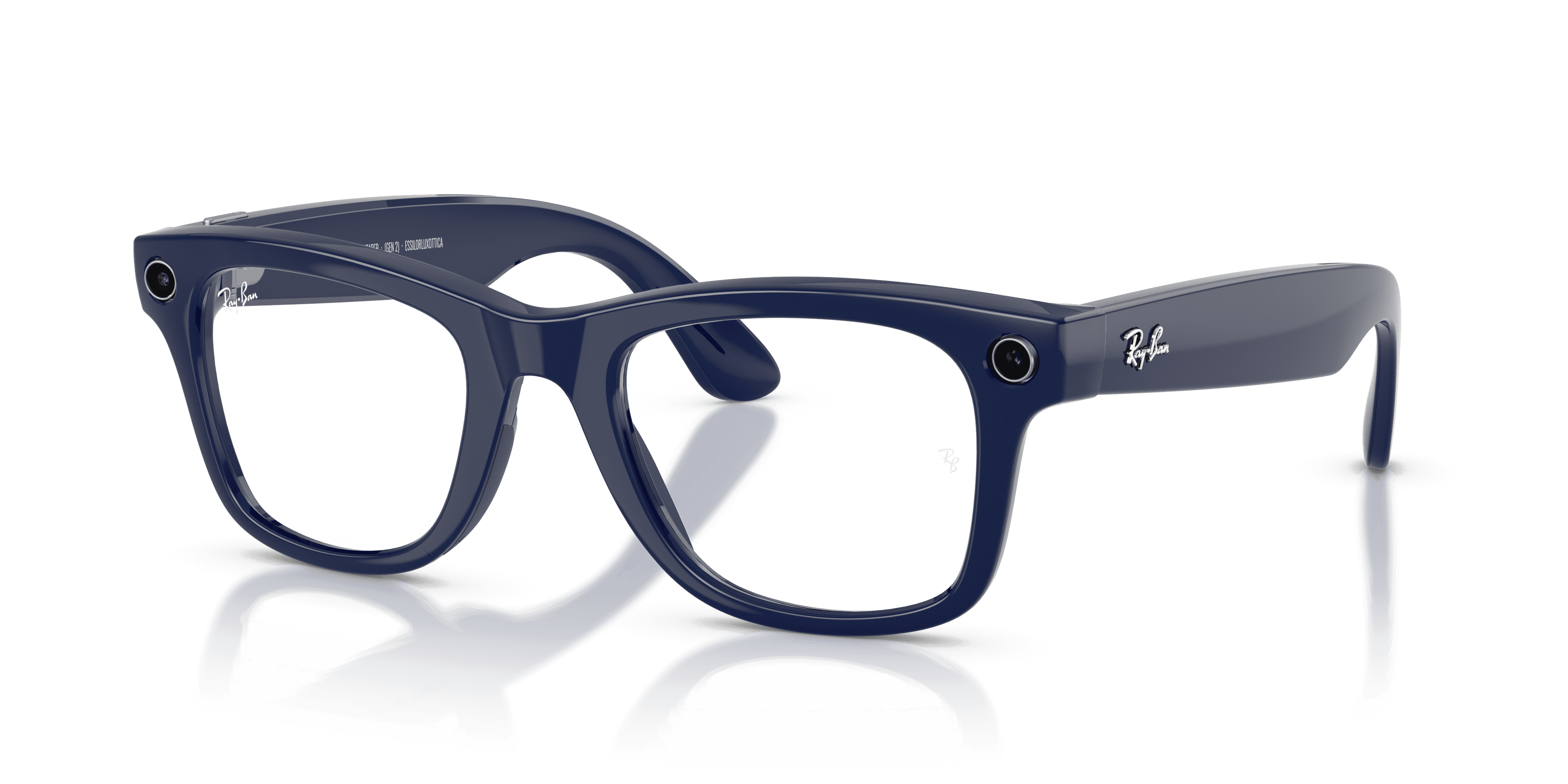
The Ray-Ban Meta Wayfarer Gen 2 lists at $379, with the original Gen 1 still available around $299 while stock lasts (verified by Ray-Ban listings at time of writing). That’s the number in every ad. Here is what a prescription wearer actually pays.
Prescription lens pricing. Ray-Ban runs an official prescription program through ray-ban.com and authorized opticians like LensCrafters. Expect:
- Single vision: roughly $100–$200 on top of the base price, depending on lens index and coatings.
- Progressives and specialty options (Transitions, polarized): $200–$300+. Complex prescriptions climb from there.
- Turnaround: about 5–7 business days through the official program — faster than most boutique smart glasses brands.
Prescription range: approximately -6.00 to +4.00 (brand-supplied). This is the Ray-Ban Meta’s quiet limitation. It covers the majority of prescription wearers, but if you sit outside that range, Ray-Ban’s official program won’t fill your order — and third-party lens replacement on camera glasses voids more warranty than it’s usually worth. Strong prescriptions push you toward the G2 whether you planned it or not.
What the base price does include: the 12MP camera, open-ear speakers, the Meta AI assistant, and the charging case. Battery life roughly doubled versus Gen 1 (brand-supplied claim we found broadly consistent in testing). No subscription is required for core camera, audio, or AI features.
One tier to be aware of: the Ray-Ban Meta Display edition at $799 adds a heads-up display. If a HUD is the feature pulling you toward smart glasses, compare that $799 (plus prescription lenses on top) against the G2’s $599-with-HUD before assuming Ray-Ban is the budget path — because at the Display tier, it isn’t.
Realistic Ray-Ban Meta totals: ~$479–$579 single vision, ~$579–$679 with progressives on the Gen 2 frame.
Buy it now: Check Ray-Ban Meta price on Amazon
The Hidden Costs Nobody Puts on the Pricing Page
Both brands are honest about their sticker prices. The costs below are the ones we only learned by owning the hardware.
1. Your prescription changes; the lenses don’t come free twice. Prescriptions drift, typically on a one-to-two-year cycle. When yours changes, a regular frame costs you one set of replacement lenses at your local optician. Smart glasses usually route you back through the brand’s lens program at similar prices to the original order — budget $100–$200 per prescription change into any multi-year cost estimate, for either brand.
2. Lens damage is frame-level risk. Scratch a lens on $150 optical frames and you shrug. Scratch a lens on electronics-carrying frames and the replacement still runs $100+, and any third-party shortcut risks the seal and the warranty. A $30 hard case and actually using it is the cheapest insurance in this category.
3. Accessories with real prices. The G2’s optional R1 ring is $249. Ray-Ban sells replacement charging cases and lens variants at accessory prices you should check before you need them (needs verification at ray-ban.com for current rates). None of these are mandatory. All of them are one impulse away.
4. The costs neither pair has. Worth naming, because the wearables category has trained buyers to expect worse: no subscription for core features on either pair, no paid app, no cloud storage toll for basic use. Over three years, that’s a $0 line where a $10/month subscription wearable would quietly add $360.
Can Insurance, FSA, or HSA Money Pay for This?
Partially — and the details depend entirely on your plan, so treat this section as a checklist for the phone call, not a promise.
- The prescription lens portion is the strongest candidate. Prescription lenses are a qualified vision expense under most FSA/HSA rules, and several smart glasses buyers report successfully applying FSA funds to the lens line item when it’s invoiced separately (needs verification with your plan administrator).
- The frame portion is murkier. Vision insurance frame allowances are written for eyewear, and some plans will apply the allowance to a smart frame with a valid prescription order; others explicitly exclude electronics. Ask before you order, and get the answer in writing.
- Itemized invoices are your friend. Both Even Realities and Ray-Ban’s official program can produce orders where lenses appear as a distinct line — that’s the document your FSA administrator wants.
If your plan covers even a $150 frame allowance plus the lens portion, the effective G2 price drops into the mid-$400s and the Ray-Ban Meta into the mid-$300s. That’s a large enough swing to be worth twenty minutes on the phone.
The Comparison That Actually Matters: Cost Per Day of Wear
Here’s the reframe we landed on after 60 days of daily G2 wear: prescription smart glasses replace your primary eyewear, so the fair comparison isn’t against other gadgets — it’s against the glasses you’d buy anyway.
| Setup | Typical 2-year cost | Cost per day |
|---|---|---|
| Premium optical frame + progressive lenses | ~$600 | ~$0.82 |
| Even Realities G2 + progressives | ~$799 | ~$1.09 |
| Ray-Ban Meta Gen 2 + progressives | ~$629 | ~$0.86 |
| Budget online glasses + separate smartwatch | ~$500 | ~$0.68 |
Read that table honestly and the story is: the Ray-Ban Meta with prescription lenses costs about the same per day as decent conventional glasses, and the G2 costs about a quarter more per day than the premium optical frames it physically resembles. Neither is the extravagance the sticker price implies — if you actually wear them as your everyday glasses. If they end up in a drawer while you wear your old frames, the cost per day is infinite and none of this math rescues you.
That’s also the honest filter for the whole category: the buyer who wins on cost is the one replacing a real eyewear purchase, not adding a fifth gadget.
Which One Is Cheaper for You?
| If you… | Your cheaper real-world option |
|---|---|
| Have a mild prescription (-6.00 to +4.00) and want a camera | Ray-Ban Meta Gen 2 — ~$479–$679 all-in |
| Have a strong prescription outside Ray-Ban’s range | Even Realities G2 — the only option here that fits -12.00 to +12.00 |
| Want a heads-up display | Even Realities G2 at $599 beats Ray-Ban Meta Display at $799 + lenses |
| Want the lowest possible entry price | Ray-Ban Meta Gen 1 near $299 + lenses, while stock lasts |
| Are replacing $500+ optician frames anyway | Even Realities G2 — the premium is small against what you already spend |
| Need cameras banned from your workplace or around kids | Even Realities G2 — no camera, no social friction, no second pair |
FAQ
Q: How much do prescription smart glasses cost in total in 2026?
Between roughly $399 (Ray-Ban Meta Gen 1 with basic single-vision lenses) and $900+ (Even Realities G2 with progressives plus accessories, or Ray-Ban Meta Display with lenses). The realistic center of the market is $500–$800 all-in.
Q: What is the Even Realities G2 price with prescription lenses?
$599 base; progressive prescription lenses added about $200 in our orders, for ~$799 all-in. Single-vision configurations come in lower — confirm lens bundling at checkout, as Even Realities has bundled standard lenses into the base price on some configurations.
Q: Are prescription lenses for Ray-Ban Meta expensive?
Expect $100–$300 on top of the frame depending on lens type. Single vision sits at the low end; progressives, Transitions, and polarized options at the high end. Supported prescription range is approximately -6.00 to +4.00 (brand-supplied).
Q: Do either of these require a subscription?
No. Core features on both the Even Realities G2 and Ray-Ban Meta work without any recurring fee. This is unusual in wearables and materially changes multi-year cost of ownership.
Q: Can I put my own lenses in from a local optician?
Technically sometimes, practically don’t. Third-party lens fitting on electronics-carrying frames risks the warranty and, on camera-equipped frames, the housing seal. Both brands run official prescription programs; use them.
Q: Will vision insurance cover smart glasses?
Plans differ. The prescription lens portion is commonly FSA/HSA-eligible; frame allowances sometimes apply and sometimes explicitly exclude electronics (needs verification with your specific plan). Get an itemized invoice either way.
Bottom Line
The honest 2026 numbers: ~$599–$799 all-in for the Even Realities G2 depending on your lenses, and ~$479–$679 all-in for the Ray-Ban Meta Gen 2 with prescriptions. The advertised gap between these two pairs is mostly an illusion created by sticker pricing — prescriptions compress it to a hundred dollars and change.
So decide on the product, not the sticker. Camera, speakers, and the most polished AI assistant: Ray-Ban Meta. HUD, camera-free privacy, extreme prescription range, and all-day optical-grade comfort: Even Realities G2. Both are fairly priced against the conventional eyewear they replace, neither charges rent after purchase, and the most expensive mistake available in this category is still buying the pair you won’t actually wear.
Affiliate disclosure: This guide contains affiliate links. We earn a small commission if you buy through them, at no extra cost to you. Our recommendations are based on hands-on testing and are never influenced by commission rates. See our affiliate disclosure for details.